BSC Tax Tokens: Transfer Fees, Exemptions and Owner Controls
Evaluate BSC token transfer taxes, exemptions and retained owner controls before choosing a taxable contract configuration in SlingZero.
Illustration and design · SlingZero
A BSC tax-token design needs both an initial transfer-fee policy and a clear record of who can change rates, destinations or supported exemptions. It should be treated as a product rule with operational consequences, not as an extra percentage added at the end of a launch form. Holders, distribution operators and liquidity providers all need to know what the rule applies to.
Separate the rate from the power to change it
A displayed rate is one part of the design. The ability to alter that rate, exempt an address or apply other administrative controls is another. Review both before deployment and describe them separately in project documentation.
The ownership and role patterns documented by OpenZeppelin help explain why a permission inventory matters. The actual deployed implementation determines which controls exist and how they can be changed.
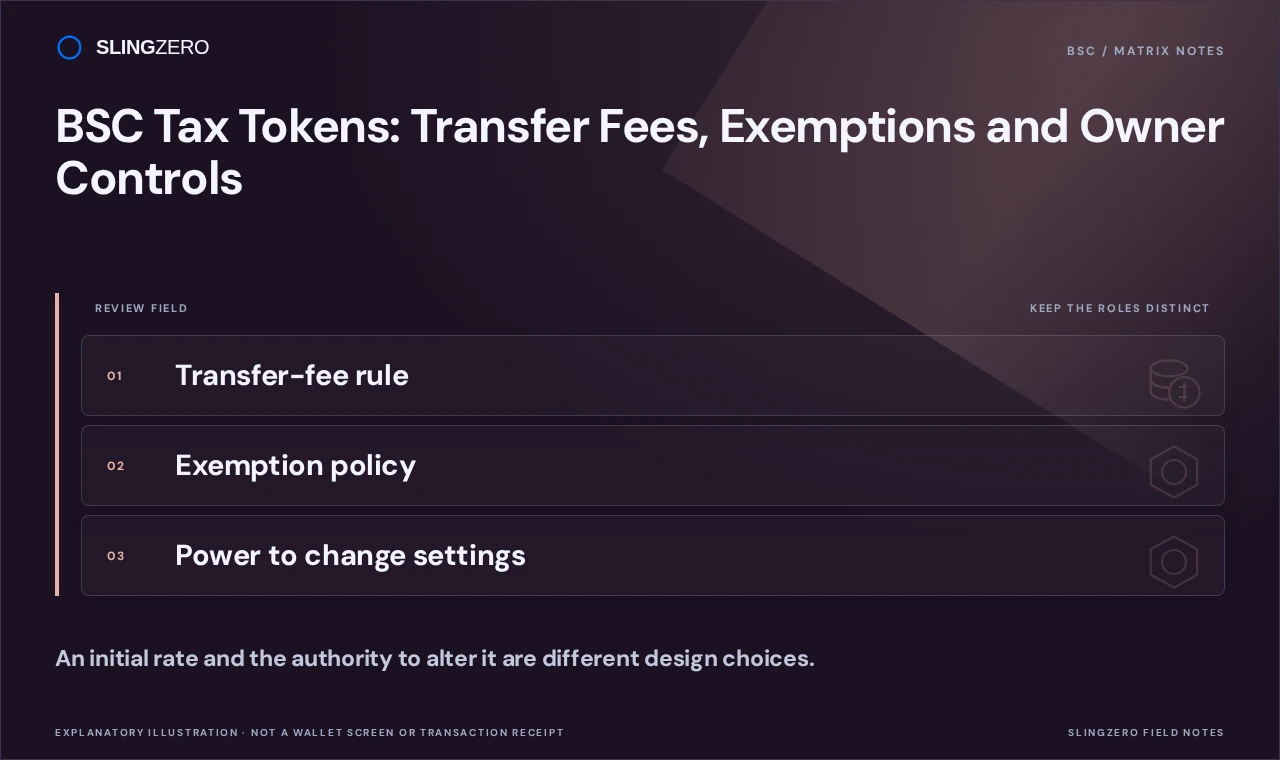
Concept illustration — An initial rate and the authority to alter it are different design choices.
Inspect the supported creator instead of assuming a universal template
Use the BNB Chain token creator to inspect the templates offered by SlingZero. Select Taxable token to inspect its Tax address and Tax fee fields.
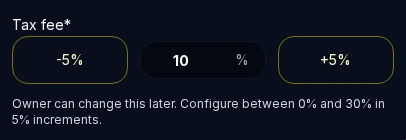
Transfer-tax rate control in the live BNB Chain creator. This setting alone does not demonstrate transfer behavior or exemptions. Open this tool. Click the screenshot to enlarge.
Confirm that the intended taxable configuration is supported on the selected network. Review the unit used for the rate, any limits shown, the initial recipient and the owner settings. Do not infer that a number copied from another token's guide has the same units or allowed range here.
Selecting Taxable token reveals the actual Tax address and Tax fee fields. The first is the destination for collected fees; the second is the initial rate. The captured form describes an owner-adjustable rate and its supported increments. Review those live limits before choosing a value. A treasury destination and an exemption policy answer different questions, so record both separately.
Design an exemption policy
An exemption should have a reason that can be explained without relying on private assumptions. Examples of questions to resolve include whether a treasury distribution is expected to be taxed, how a supported pool interacts with transfers, and who can authorize changes to the exemption list.
Keep an address inventory and review complete addresses rather than wallet nicknames. Test the token's actual behavior in an appropriate controlled environment before promising a specific net amount to recipients. A nominal transfer amount and the amount a recipient receives may differ under the implementation's rules.
Consider the effect of losing administration
If ownership is later renounced, identify which tax-management functions would become unavailable. An exemption or setting that still needs correction should be resolved before surrendering the permission required to change it. Other role or proxy controls may exist independently, so inspect them as well.
The public description should distinguish the current settings from the powers that remain. It should also avoid claims that a transfer tax guarantees rewards, liquidity or price support. A clear design document explains observable token behavior and administrative authority; it does not turn implementation choices into promised economic outcomes.