How to Burn a BSC Token: A Practical BEP-20 Guide
Learn how to burn compatible BEP-20 tokens on BNB Chain, check wallet balances and contract support, and verify the supply change after signing.
Illustration and design · SlingZero
Key takeaways
- A contract burn and a transfer to a dead address are different operations.
- SlingZero's BSC burn workflow calls a compatible token's burn function.
- Confirm the chain, contract address, amount, gas, and service fee before signing.
To burn a BSC token with SlingZero, the BEP-20 contract must support the intended burn and the connected wallet must control the balance being retired. The first question is whether the specific BEP-20 contract supports the intended operation. A token ticker alone cannot answer that: unrelated contracts can share a name.
What a token burn actually changes
A compatible contract burn reduces the caller's token balance and its recorded total supply. Sending tokens to a commonly used dead address generally moves a balance without calling that supply-reduction function. Describe the transaction accurately in any community announcement.
OpenZeppelin's ERC-20 extension reference documents burnable tokens as an optional extension. A BEP-20 label by itself does not establish that a particular deployment exposes the same interface. Custom permissions, pauses, and other restrictions can also affect execution.
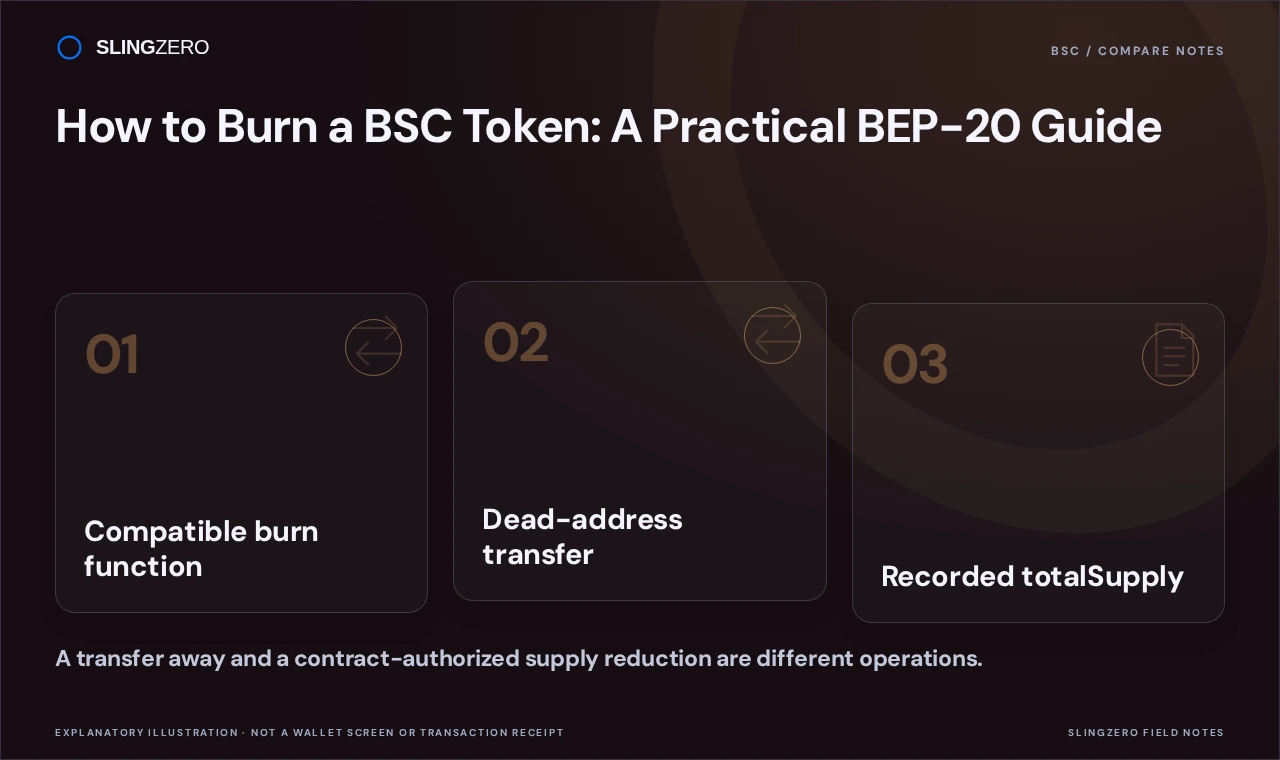
Concept illustration — A transfer away and a contract-authorized supply reduction are different operations.
Before you begin
Copy the contract address from a source you have independently verified. Connect the wallet holding the tokens, select BNB Chain mainnet, and keep BNB available for gas. Check the current wallet balance rather than relying on a screenshot or an earlier portfolio value.
Write down the intended amount in whole-token units and compare it with the decimals displayed by the tool. For a treasury operation, record why the amount is being retired and who approved it. A burn is a poor place to discover an extra zero.
Burn a compatible token with SlingZero
- Open the BSC token burn tool.
- Connect the wallet and confirm that it is using the intended BNB Chain network.
- Select or enter the exact token contract and inspect the loaded token details.
- Enter the amount. Compare it with the current balance and the project's burn plan.
- Review every displayed service-fee and token transaction. A fee payment alone is not proof that tokens were burned.
- Inspect the wallet request, including the destination contract and requested operation, before approving.
- Wait for a successful onchain receipt and retain its transaction hash.
If a simulation or transaction fails, check the contract's supported methods, account permissions, available gas, and current balance. Repeating the same request blindly can waste fees and obscure which transaction actually completed.
Verify the result and communicate it clearly
Open the successful transaction on the chain explorer and inspect the token contract, sender, and amount. Refresh both the wallet balance and the contract's total supply. An emitted event is useful evidence, but reading the resulting contract state gives a clearer record of what changed.
A public burn report can include the transaction hash, quantity, chain, contract address, and before-and-after supply. Avoid claims that a smaller supply automatically creates demand or raises a market price. The operation changes token accounting; market outcomes depend on other factors.
FAQ
Fast answers for founders comparing token launch, authority, liquidity, and post-launch workflows.
Can I burn tokens from someone else's wallet?
This workflow is for a compatible balance and the permissions available to the connected account. Do not assume a holder-facing burn tool can remove another holder's balance.
Is sending tokens to a dead address the same as burning them?
It may remove them from ordinary circulation, but it does not necessarily decrease the contract's recorded total supply. Identify which operation you actually performed.
Can a burn be reversed?
A completed burn is irreversible. A contract with retained minting permission may allow new issuance later, which is a separate operation rather than recovery of the burned tokens.