Arbitrum Liquidity Pools: Turn Deposit Amounts Into a Ratio
Convert Arbitrum liquidity deposit amounts into an opening ratio. Check token order, decimals, quote units and the actual pool form.
Illustration and design · SlingZero
For a new constant-product liquidity pool on Arbitrum, the opening deposit ratio determines the initial quote between the selected base and quote assets. It is worth calculating outside the form before the wallet request appears. This is a units exercise, not a prediction of what the token will trade for after other participants interact with the market.
Work through a hypothetical pair
Suppose an operator proposes depositing 200,000 units of a project token and 2 units of its quote asset. Dividing quote units by base units gives an opening ratio of 0.00001 quote units per project token. The inverse is 100,000 project tokens per quote unit.
Illustrative deposits — not a live quote
Base:   200,000 project tokens
Quote:  2 quote-asset units

Quote / base = 0.00001 quote units per project token
Base / quote = 100,000 project tokens per quote unit
Both statements describe the same ratio. Neither tells you the token's value in another currency without additional information about the quote asset. Check decimals independently for both tokens, especially when comparing human-readable values with smallest-unit representations.
The Uniswap v2 pool explanation is useful background for this constant-product relationship. It is not a statement that every Arbitrum pool uses the same router, fees or pool model.
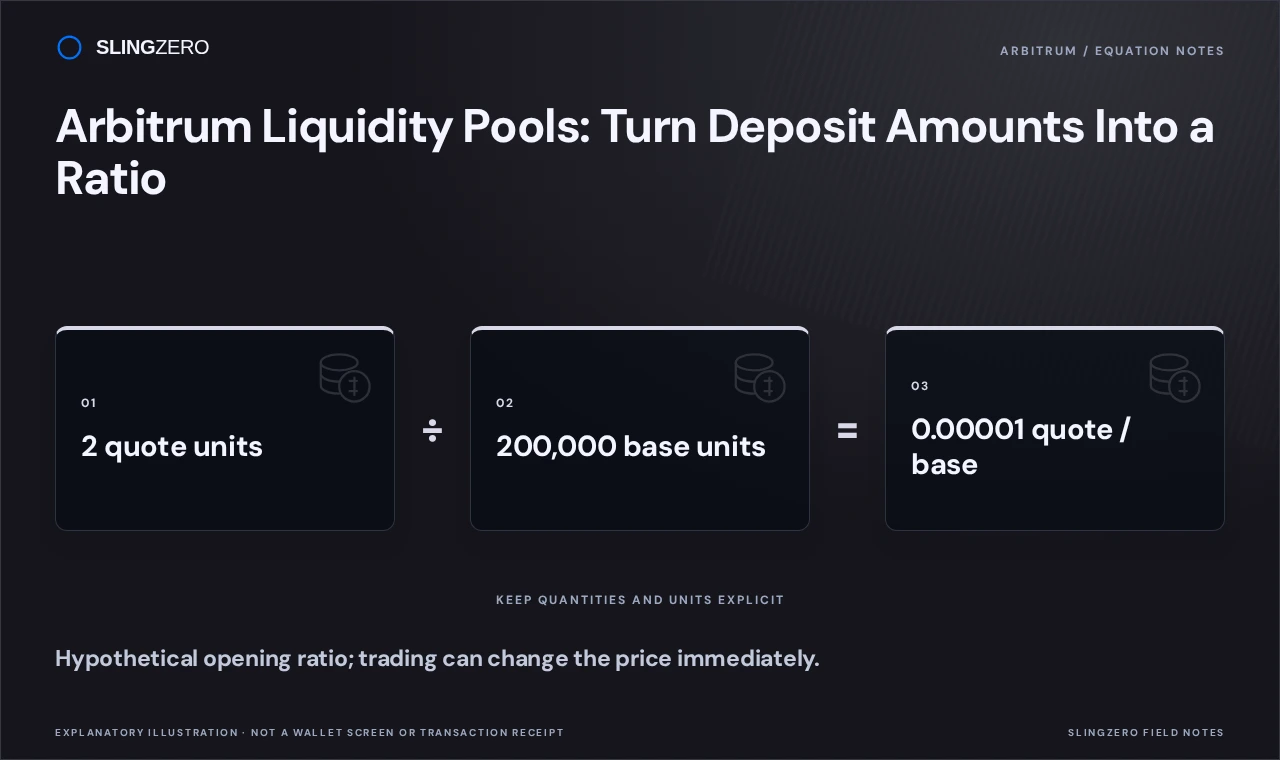
Concept illustration — Hypothetical opening ratio; trading can change the price immediately.
Compare the arithmetic with the actual form
Open Create liquidity on Arbitrum. Confirm the supported venue, base contract (for example one deployed with the Arbitrum ERC-20 deployer) and quote asset before entering deposits.
Use the form's preview to check the calculation, not to replace identification of the assets. A correctly computed ratio for the wrong contract is still the wrong pool. Verify the chain and retain the identifiers used for both sides.
Ask whether the pool already exists
Seeding a new pool and adding assets to an established pool are different contexts. Where a pool already has reserves, review its current state instead of assuming that your proposed deposits will establish a fresh opening ratio. A mismatch can create an outcome that differs from the operator's intention.
Review slippage, approvals, the LP recipient and the live costs. Keep enough of the native gas asset available after accounting for the proposed deposit. If the workflow requires separate approvals, track them independently of the actual liquidity transaction.
Record the observable outcome
After confirmation, inspect the pool identifier, assets, reserves and resulting position. Save the transaction hash alongside the preflight calculation. A later interface refresh should be compared with this record rather than treated as the only proof of completion.
The initial ratio is not a guaranteed market price. Trading can move it, and other venues may quote the asset differently. Likewise, providing liquidity does not itself prove that withdrawal rights were locked or destroyed; the Arbitrum liquidity manager can only remove LP tokens the connected wallet holds. Describe each separate action with the evidence that supports it.