Ethereum Multisender Approvals: Amount, Spender and Revocation
Review Ethereum multisender allowances by token, spender and amount. Separate approval from distribution and plan how to reconcile partial batches.
Illustration and design · SlingZero
Ethereum multisender approvals authorize a particular spender and amount for an ERC-20 token; a confirmed allowance does not prove the distribution completed. There may be an ERC-20 allowance transaction and then a separate distribution transaction. Knowing which permission each wallet prompt grants helps prevent an operator from mistaking preparation for completion.
The three values to inspect
Token: the exact contract whose balance can be spent.
Spender: the contract being authorized to move those units within the allowance.
Amount: the scope of that permission in the token's units.
The ERC-20 specification defines the allowance interface. Read those values in the actual request; the presence of a familiar application name is not a substitute for checking the spender and token.
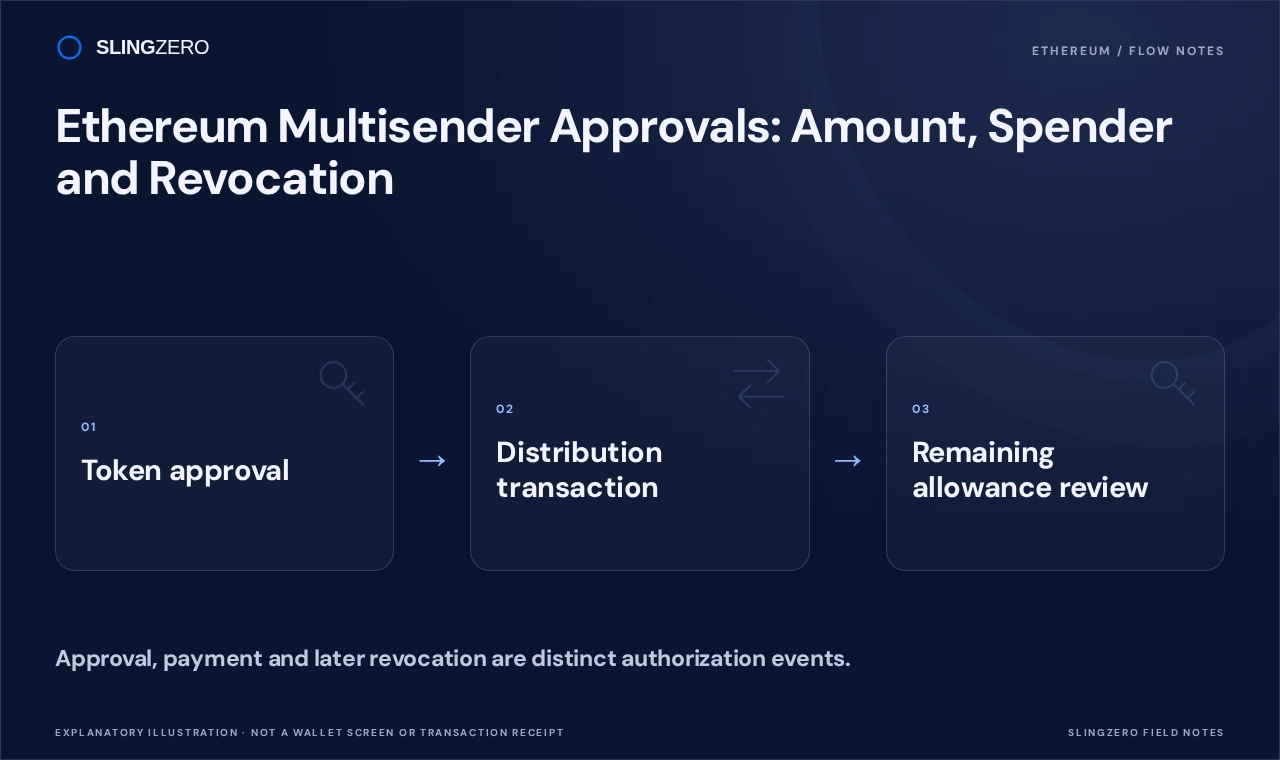
Concept illustration — Approval, payment and later revocation are distinct authorization events.
Where the allowance fits into a batch
Open Ethereum multisender, connect the distributing wallet and select the intended token. Review recipients and reconcile their total before considering any allowance request.
An approval can succeed even if the distribution is later rejected or fails. Keep those transaction hashes separate. The recipients have not necessarily received anything simply because the allowance is now visible onchain.
For a token with unusual transfer behavior or approval requirements, consult its implementation before treating it as interchangeable with a plain transfer token. A list that adds up correctly can still produce unexpected results if the asset applies restrictions or fees.
Review the distribution itself
After permission preparation, inspect the intended distribution request. Verify the network, destination contract, recipients and overall amounts presented by the tool. Preserve the list version used for execution so a changed spreadsheet does not make reconciliation ambiguous.
Large distributions can involve multiple transactions. Track their completion individually. If only part of the work succeeded, build a remaining-recipient list from confirmed results rather than resending the original allocation indiscriminately.
Close the permission loop
After the intended distribution is confirmed, inspect whether an allowance remains. Decide whether that remaining permission is needed for a documented next operation. If it is not, use a trusted allowance-management method appropriate to the token and verify the change onchain.
Allowance review is an operational habit rather than a promise that a token or application is risk-free. The useful record states what was authorized, what was actually distributed and what permission remains. That makes the process reviewable without asking a future operator to reconstruct every wallet popup from memory.
A final distribution report should therefore include two kinds of evidence: the permission transactions where relevant, and the successful transfers. Neither record substitutes for the other.