Manage Raydium Liquidity: What Your LP Balance Controls
Understand what a Raydium liquidity position controls. Compare LP ownership, pool identity, withdrawal rights and SlingZero’s management screen.
Illustration and design · SlingZero
Managing Raydium liquidity begins with identifying the pool and the wallet’s actual LP holding or supported position, rather than its ordinary project-token balance. A project can hold plenty of its own token while no longer controlling the LP position that would let it remove a deposit. Start liquidity management by identifying the position, not by guessing an amount to withdraw.
What exactly does the wallet hold?
For a supported constant-product position, LP ownership represents a claim governed by that pool's rules. Other pool models can represent positions differently. The Raydium CPMM documentation provides background for the constant-product model; do not treat it as a description of every concentrated-liquidity position.
Record the pool address, both token mints and the asset representing the wallet's position. Check whether that position is freely held, staked, locked, transferred or burned. Those states can have very different consequences for what the wallet can do next.
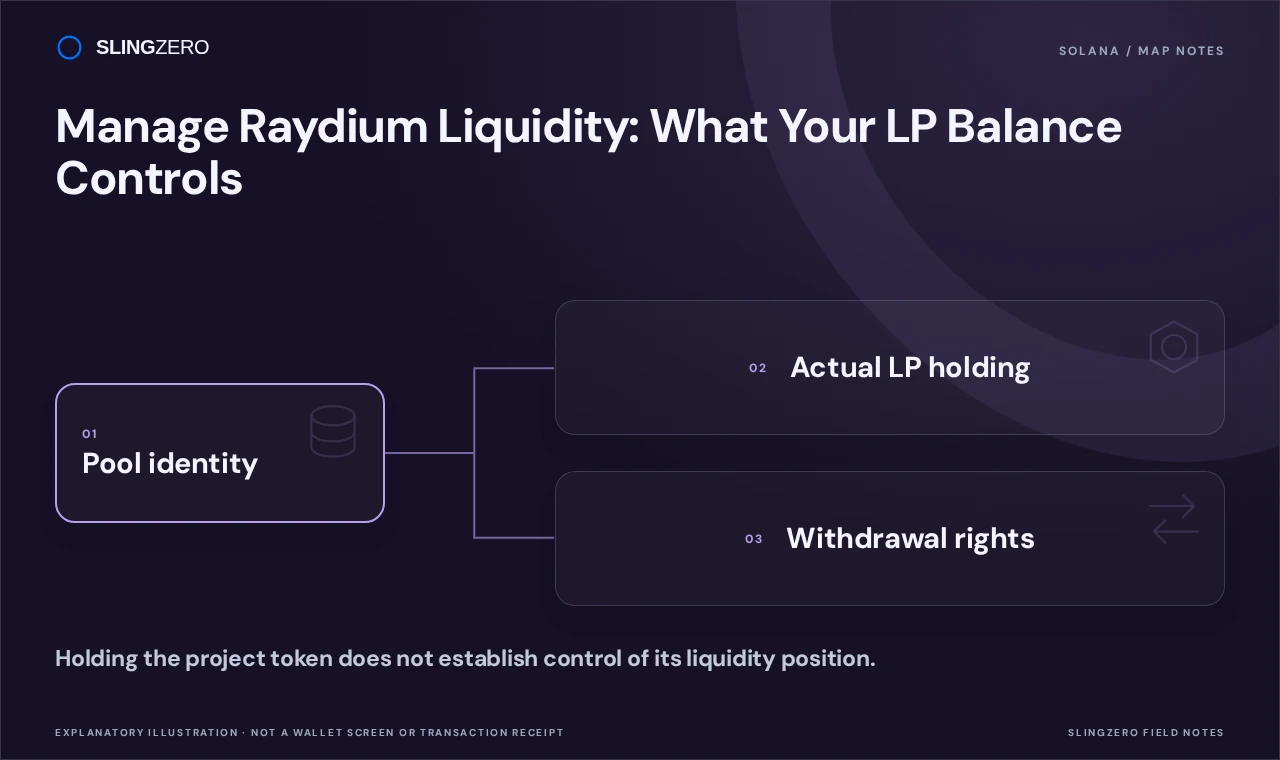
Concept illustration — Holding the project token does not establish control of its liquidity position.
Read the manager before choosing an action
Open the Solana liquidity manager.
Connect the wallet that controls the supported position and confirm the network. Verify the loaded pair and position details before choosing an addition or removal. A matching token ticker is insufficient: a project can have more than one pool or quote asset.
For an addition, compare the intended deposits with the existing pool context. For a removal, review the LP amount or proportion being consumed and the assets expected back. Inspect slippage and all costs presented in the live workflow.
Reconcile the result as two records
Keep a position record showing how much of the LP holding changed. Keep an asset record showing which underlying token balances changed after confirmation. A wallet balance alone can be misleading if an indexer has not refreshed or if the operator is inspecting a different pool.
Retain the successful signature and compare the actual transaction with the planned action. If a request stops midway, determine which transactions completed before retrying. An approval or fee payment is not proof that the liquidity deposit or withdrawal occurred.
The claim you can substantiate
Providing liquidity does not automatically lock it. Holding the project's token does not automatically grant withdrawal rights. A public statement about liquidity custody should identify the pool and the evidence for control, lock or burn status.
If withdrawal rights are intentionally relinquished, document that separately from the original deposit. Future treasury planning should not rely on assets that the project no longer has permission to recover. A clear LP inventory turns a vague launch promise into a position that can actually be audited.